Double Vision: Reflections on Originals, Copies, and the Mystery of Value
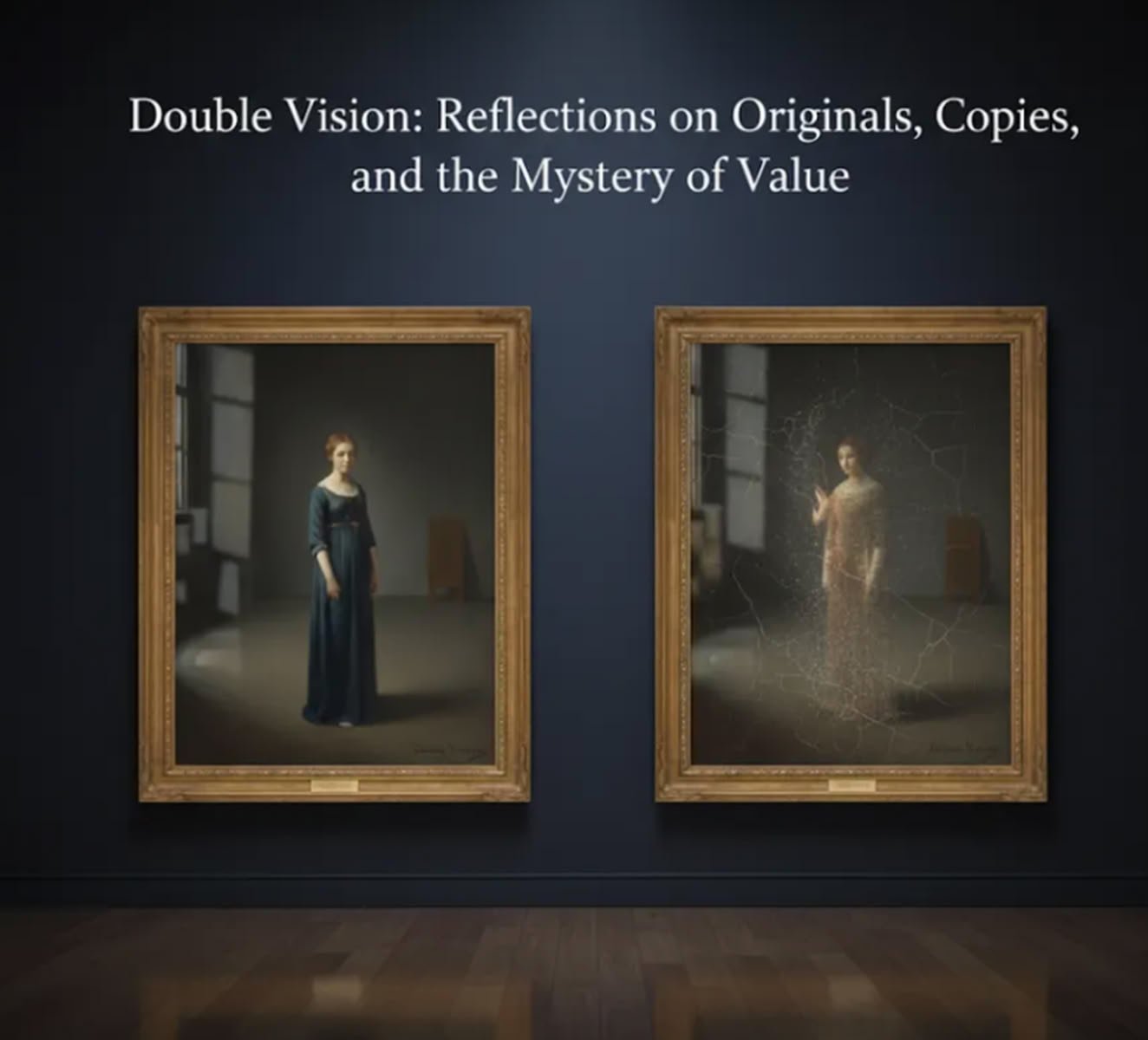
I recently came across a story about two paintings — one an undisputed Vermeer, the other a
mysterious twin that looks almost the same but carries no signature. They are now displayed
side by side in London, and experts debate what this “second version” really is. A copy? A
student exercise? A failed experiment? Or something more?
Reading about it, I realized this is more than an art mystery. It feels like a mirror held
up to life itself. We all deal with questions of originality, authenticity, and duplication
— not just in paintings, but in people, in choices, in how we live day to day.
The weight of being “original”
There is always a pressure to be original. We praise uniqueness, innovation, and creativity,
while we look down on what we call imitation. Yet, the more I think about it, the harder it
is to define originality. What is truly original in this world? Every new idea is built on
something that came before. Every word we say has been said by someone else in another
way.
Maybe originality is not about inventing something completely new but about leaving a trace
that only you could leave. Like Vermeer’s brushstrokes — the pigments, the textures, the
little details that even a near-perfect copy cannot fully reproduce. In life, our
originality may be in the details too: the way we laugh, the way we love, the way we
fail.
Copies are not empty
We tend to dismiss copies, but sometimes copies reveal truths the original hides. The “twin”
Vermeer doesn’t have the expensive pigments or the signature. It might be technically less
valuable, but it forces us to ask: why do we value one object more than another? Is it the
scarcity? The brand of the name? Or the story we attach to it?
In our own lives, we “copy” constantly — habits, behaviors, even dreams borrowed from people
around us. That doesn’t always make them worthless. Sometimes imitation is the first step
toward finding a voice. Sometimes what looks like a copy is, in fact, a reflection of
something deeply real.
Time as the ultimate painter
Another thought that struck me is how time itself becomes an artist. The twin painting
carries cracks, faded colors, and pigments that don’t shine like the original. But isn’t
that what happens to all of us? Time paints us with its own palette. It erases, it fades, it
adds lines where there were none.
And strangely, those marks of time carry authenticity of their own. A flawless surface can
be suspicious; a cracked one tells a story. Maybe the same is true of people. The scars, the
wrinkles, the mistakes — these are not flaws but evidence that we were here, that we
lived.
Everyone has a twin
When I think about the idea of a mysterious double, I can’t help but connect it to the human
experience. Each of us has an “original” self we project to the world and a “twin” self that
lives in the shadows. One signed, one unsigned. One polished, one raw.
Sometimes we prefer to show the signed version, the part of us that looks official,
presentable, worth recognition. But the unsigned version is no less real. It might even be
more honest, less concerned with approval. Just like with the paintings, the absence of a
signature doesn’t mean absence of value.
What gives something its worth?
The story of these two canvases is a reminder that value is not absolute. A painting can be
priceless not because of the pigments on the surface, but because of the narrative we build
around it. In the same way, a person’s worth can’t be reduced to a job title, a bank
account, or a diploma. These are just the “signatures.” What really matters is harder to
measure: the kindness we give, the love we share, the ideas we spark in others.
We live in a world obsessed with proof and labels, yet some of the most important things
come unsigned. A moment of joy, a shared glance, a lesson learned in silence. These have no
certificate of authenticity, but they are real.
In the end
The Vermeer exhibition is more than an art event. It is a metaphor about life. Originals and
copies coexist, and both have something to teach us. Perfection is not the only path to
truth. Time is not an enemy but a collaborator. And every one of us has a signed version and
an unsigned version, both equally part of who we are.
Maybe we don’t need to chase originality with desperation. Maybe the point is simply to live
in such a way that, signature or not, something of us remains — something unmistakably
ours.
Because whether we are the original painting or the mysterious twin, we are still
here, hanging side by side, waiting for someone to look closely enough to see us.