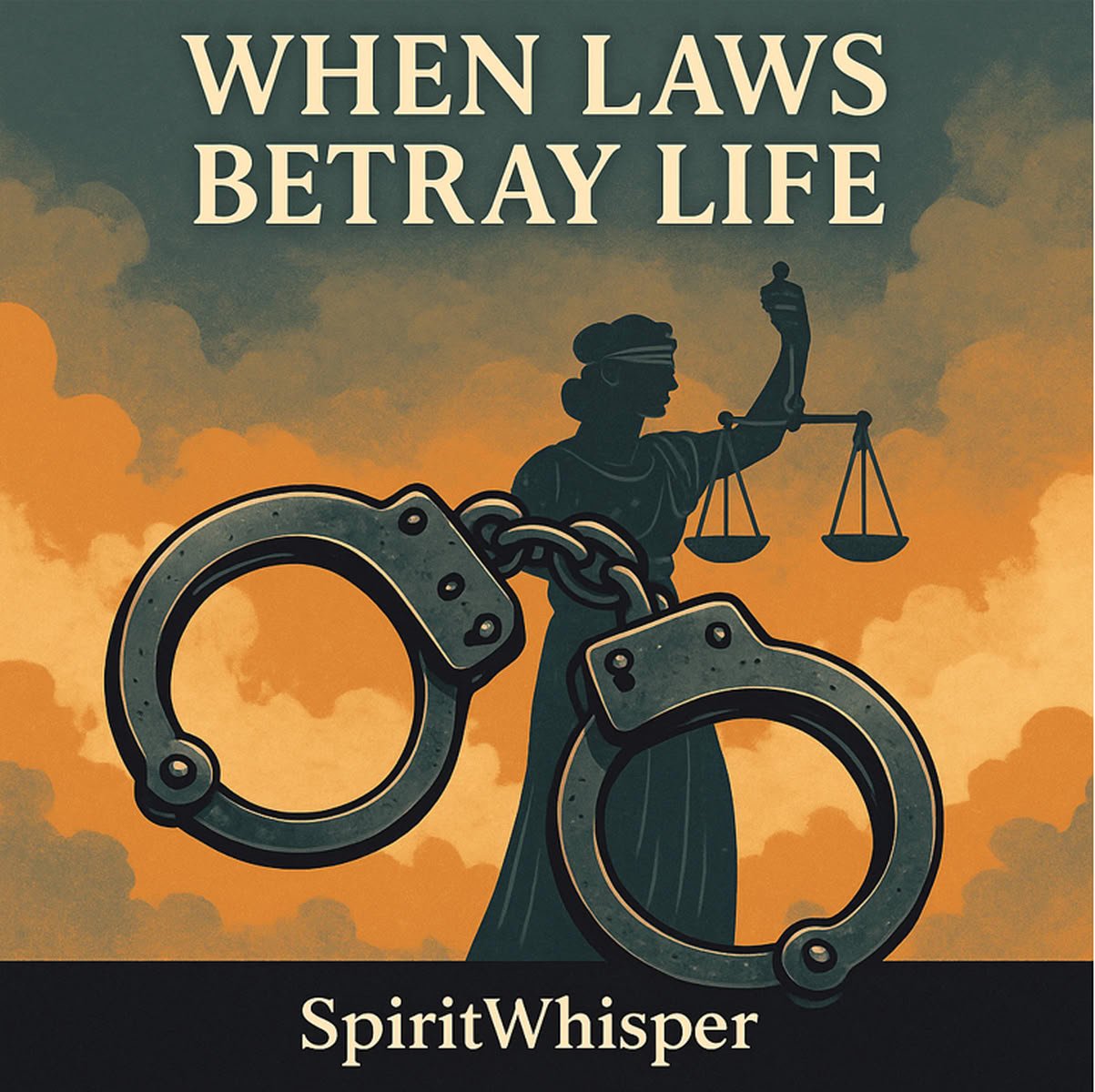
When Laws Betray Life
I often find myself asking a simple question: what is the difference between what is
legal and what is right? On the surface, the two should align. Laws are supposed to be
the written expression of a society’s sense of justice, fairness, and morality. But when
I look around, I see a widening gap. I see situations where the law calls someone a
criminal, while common sense and human decency would call them a neighbor, a teacher, or
a fellow human being.
This is not about one story in the news. Stories like that come and go, splashed across
headlines for a week and then buried under the next wave of scandals. What concerns me is
the pattern that repeats, the way entire systems seem designed not to protect life but to
protect their own authority. I have learned that in this world, you can dedicate your life
to helping others, and still, one technicality, one missing document, or one sudden change
in policy can strip away your humanity in the eyes of the law.
The Comfort of Labels
I notice how easily society reduces people to labels: “illegal,” “undeserving,” “criminal,”
“alien.” These labels are convenient because they save us from confronting the complexity of
real human lives. A man who builds communities for decades can be erased overnight with a
single label. A woman who raises children and contributes to her neighborhood can be reduced
to a case file in an immigration office.
I think about myself when I confront this logic. I am not exempt from being reduced, even if
in different ways. At work, in society, even in conversations, I sometimes feel how quickly
others categorize me — manager, worker, foreigner, dreamer. These labels never capture the
whole story, yet they carry power. They can open doors or slam them shut. They can give
someone authority or strip them of dignity.
Legal ≠ Moral
The system constantly reminds us that legality is not the same as morality. Slavery was once
legal. Segregation was once legal. The exploitation of workers — children included — was
legal. In every era, people justified these injustices with the same excuse: it’s the law.
And every time, history later looked back in shame.
So I wonder: what injustices of today will tomorrow’s generations look back on with
disbelief? Will they ask how we tolerated the criminalization of migration, the punishment
of poverty, the destruction of the planet in the name of “economic growth”? Will they see us
as we now see those who defended slavery or segregation — not as guardians of order, but as
defenders of cruelty dressed in legal robes?
The Cold Face of Bureaucracy
I have seen how rules and regulations operate in practice. They are faceless, mechanical,
and indifferent. A form not filled, a deadline missed, a signature missing — suddenly,
entire lives are thrown into chaos. The system never apologizes; it simply shrugs and says,
rules are rules.
I cannot count the times I’ve seen ordinary people crushed under these silent machines of
bureaucracy. Friends, colleagues, even strangers I’ve met briefly, all sharing the same
story: that the law treated them not as people but as problems to be processed. And I, too,
have felt how a system can make you feel invisible. Sometimes it’s a rejection letter,
sometimes it’s a rule at work that values productivity over humanity, sometimes it’s the
silence when you expect fairness but find only indifference.
Personal Reflections on Injustice
Whenever I encounter these contradictions, I try to remind myself: I am not powerless. Yes,
I have been disappointed, even wounded, by how often the law betrays life. But I still
believe in the power of questioning. I still believe in the power of refusing to accept the
lie that “law equals justice.”
I have carried my own small examples of this. No, I won’t detail them here, because they are
not the point. What matters is the feeling — the quiet anger of knowing that rules were
applied without compassion, that decisions were made without listening, that people were
measured in numbers instead of humanity. That feeling is universal. Many carry it silently,
but it connects us.
The Illusion of Neutrality
We are often told that the law is neutral, objective, blind. But I have never believed that.
Laws are written by people, and people serve interests. Neutrality is an illusion. A law
that criminalizes the poor while protecting the wealthy is not neutral — it is biased power
disguised as order.
I think of how often laws are enforced selectively. Some people break rules and face ruin.
Others break rules and receive applause. Corporations exploit workers, poison rivers, and
manipulate economies, and their “punishment” is a fine so small it barely dents their
profits. Meanwhile, an individual who makes a single mistake — crossing a border, missing a
document, breaking a petty regulation — can lose everything.
Choosing Humanity Over Authority
I do not believe we can wait for laws to align with justice on their own. If history teaches
us anything, it is that laws change only when people demand it. When ordinary people choose
to see the human being behind the label, when they refuse to let bureaucracy erase
compassion, then justice moves forward.
It starts in small choices: choosing not to repeat the dehumanizing language we hear,
choosing to listen before we judge, choosing to remember that every person’s story is larger
than a rulebook. I may not have the power to rewrite national laws, but I have the power to
live differently, to resist in the way I treat those around me.
Beyond the Paper Chains
When I see the contradictions of the system, I do not only see failure; I also see
possibility. The cracks in the wall reveal that the wall is not eternal. The paper chains of
law can restrain, but they cannot hold forever.
I tell myself this often: legality is not the ultimate measure of life. Humanity is. If a
law betrays life, then it is the law that is wrong, not the person. If a rule denies
compassion, then it is the rule that must change, not the heart that insists on kindness.
And so I continue. I continue to write, to question, to refuse to let the
system’s coldness silence my own fire. Because if we ever forget that distinction —
if we start believing that “legal” automatically means “right” — then we will have
surrendered our humanity.