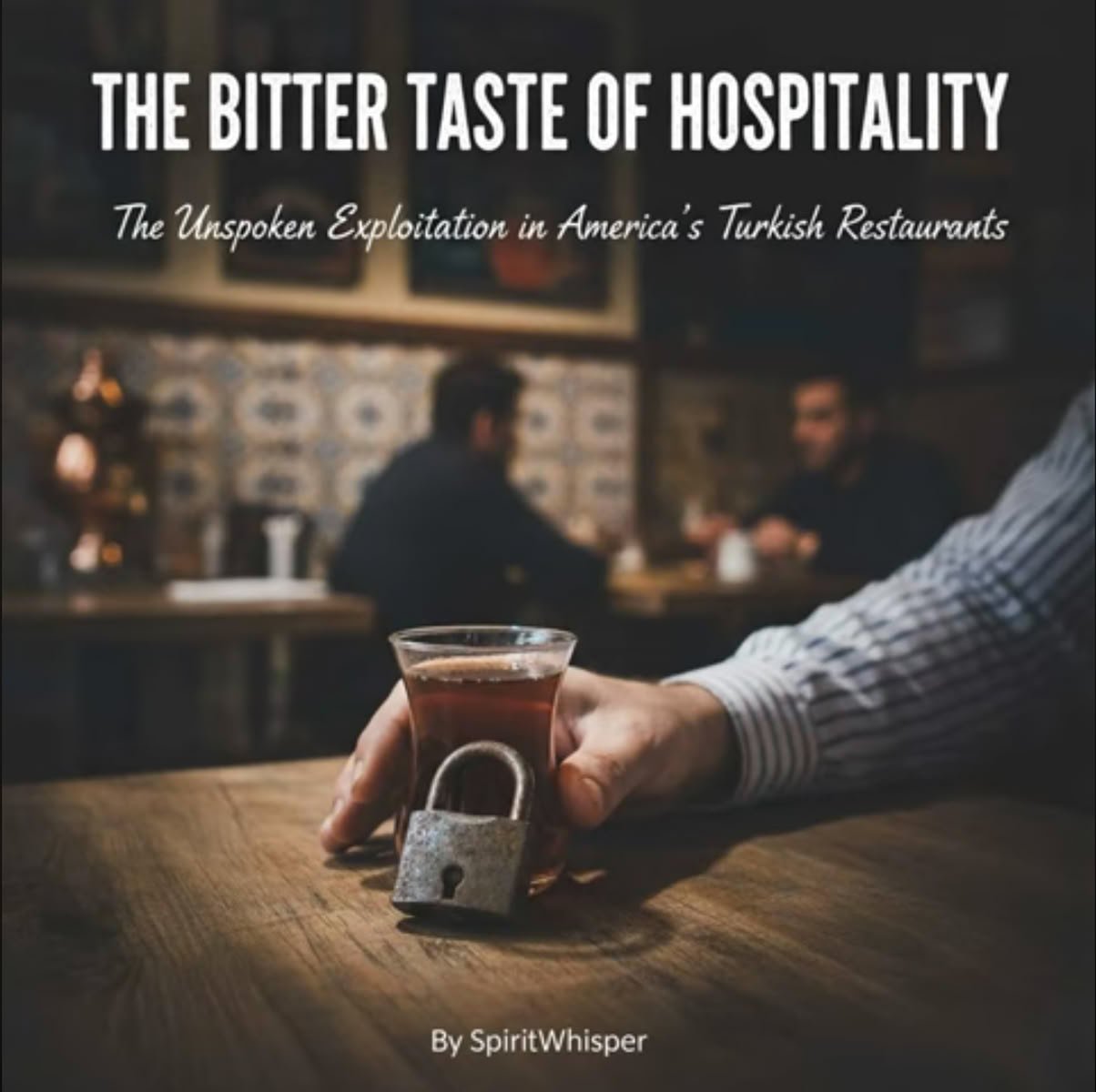
The Unspoken Exploitation in America's Turkish Restaurants
Let me start with a confession: I am hopelessly devoted to Turkish food.
There is a soul to it. It’s the sizzle of Adana kebap hitting the grill, the impossible
lightness of a well-made künefe, the quiet ritual of stirring sugar into a tulip-shaped
glass of çay. For a Turk living in America, a good Turkish restaurant isn't just a place to
eat dinner. It's an embassy of the homeland. It's a refuge, a celebration, a direct line to
our memories.
Whether I'm in the bustling heart of Manhattan, the quiet suburbs of Chicago, or the densely
packed streets of Paterson, New Jersey, walking into one of these places feels like a
homecoming.
But I’ve been forced to confront a deeply unsettling truth. That feeling of warmth and
community often stops at the dining room floor. For many of the people working tirelessly to
create that experience—the waiters navigating crowded tables, the bussers clearing plates,
the kitchen staff sweating over hot coals—that hospitality is a mask.
Beneath the surface of that famous, effusive Turkish generosity, there is a dark and
pervasive pattern of exploitation. And the more I look, the more I talk to people, the more
I realize this isn't just a case of a "few bad apples." It's a systemic rot.
We need to talk about what’s really happening behind the kitchen door.
The "Tip Credit" Con: A System Built for Abuse
The foundation of this entire broken system is the wage structure. It begins with a
perfectly legal, yet ethically bankrupt, American concept: the "tip credit."
Here’s how it works in places like New Jersey. The regular minimum wage is, say, over $15 an
hour. But for a "tipped employee" (like a waiter), the employer is only required to pay a
cash wage of $5.26 an hour. The "credit" they take is the assumption that the employee will
earn at least the remaining $10+ in tips to reach the full minimum wage.
This system is already a problem, as it effectively outsources an employer's payroll
obligation to the customer. But in the hands of many Turkish restaurant owners I’ve
observed, this "credit" is treated as a license to pay almost nothing.
I've heard countless stories of servers being paid a flat rate of $3, $4, or $5 an hour.
This isn't just leveraging a loophole; it's a deliberate strategy to minimize the single
largest business expense—labor—to near zero. The owner puts the entire burden of a worker's
livelihood onto the random generosity of the dining public.
"They get tips, it's fine," the owners say. This is the first lie. It sets the stage for a
far more sinister theft.
The Great Tip Heist: "Your" Money is "My" Money
Let's follow the money.
You, the customer, have a wonderful meal. Your server—let's call him Ahmet—is fantastic.
He's quick, he's charming, he recommends the perfect meze. You're impressed. You pay your
$150 bill and add a $30 tip, feeling good that you've rewarded Ahmet's excellent service.
Here is what happens after you walk out the door.
At the end of a grueling 12-hour shift, Ahmet, exhausted but relieved, goes to "cash out."
He has earned, let's say, $350 in credit card tips. The owner or manager meets him at the
register. And here, the gasp etmek—the usurpation—begins.
The owner says, "Give me the tip report." He looks at the $350. He then pulls $175 from the
register and hands it to Ahmet. "This is yours."
Ahmet is speechless. "What about the other $175?"
The excuses are a well-rehearsed script.
1."The House Share": "The business needs its cut. This is my restaurant."
2. "Kitchen Fees": "I have to pay the cooks and dishwashers." (This is the most common lie.
In reality, that money goes directly into the owner's pocket. The kitchen staff is on a
separate, and often just as exploitative, flat salary).
3. "Credit Card Fees": "The credit card companies charge me." (They do. About 3-4%. They do
not charge 50%.)
4. "Pooling": Sometimes they'll claim it's for a "tip pool" to be shared with bussers. While
tip pooling is legal, it is often abused, with the owner taking the largest share or
distributing it unfairly, again, keeping the lion's share for himself.
This is not a "share." This is theft. Plain and simple.
A tip is a gratuity. It is a social contract, a direct-to-consumer payment from the customer
to the server for their labor. It is not revenue. It does not belong to the owner. When an
owner dips his hand into that jar, he is stealing as surely as if he'd picked your pocket.
This practice is an open secret. In communities like Paterson, it's not the exception; it's
the rule. It's so normalized that new workers are told "this is just how it's done here."
The Modern Serfdom: "Beğenmiyorsan Kapı Orada"
This financial abuse is only possible because it's built on a deeper, more toxic foundation:
a mentality that views workers not as employees, but as property.
The worker is seen as a köle, a slave. Their time, their energy, and their dignity are all
considered to be on-demand commodities for the owner.
The 40-hour work week is a fantasy. The standard is 60, 70, or even 80 hours. Six days a
week, 12 hours a day. Overtime pay? The word doesn't exist in their vocabulary. When a
worker dares to ask for the legally mandated time-and-a-half for hours worked over 40, they
are laughed at. "You get tips, that's your overtime."
There are no breaks. "You can rest when it's quiet," the manager says, knowing full well it
is never quiet. Employees often eat their own "meal" standing up in a back alley or hidden
in the pantry, gulping down cold leftovers in 60 seconds.
And then, there is the most powerful weapon of all: the visa.
These owners specifically target the vulnerable. They hire young men and women who are new
to the country, who barely speak English, and who are desperate for a foothold in America.
They promise to "sponsor" them for a visa, to "help them with their paperwork."
This "help" becomes a chain. The moment the worker questions the stolen tips or the endless
hours, the threat is deployed: "Be grateful I'm even helping you. I can make one phone call
and you're on a plane back to Turkey." "Don't like it? Fine. Beğenmiyorsan kapı orada. (If
you don't like it, there's the door.)" "Who else is going to hire you? You're nothing
without me."
This isn't employment. This is psychological warfare. It's trapping someone, leveraging
their hopes and their legal precarity to extract labor for almost free. They are held
hostage by their American dream.
A Stain on Our Culture
What breaks my heart is the hypocrisy.
We, as a culture, pride ourselves on misafirperverlik (hospitality), on fairness, on hak
(what is right, what is due). We are a people who will fight over who gets to pay the bill.
Yet, these very same men go to work and steal the bread from the mouths of their own people.
They are staining our reputation. They are turning our most beautiful cultural embassies
into dens of exploitation. They are serving kebap with a side of wage theft and trafficking
their own countrymen's labor.
This isn't an "all of them" problem, but it is a "way too many of them" problem. And the
silence from the community is deafening.
So, what can we do? For starters, we, the customers, hold the power. Pay your tip in
cash.
Directly. Hand it to your server. Look them in the eye and say, "This is for
you, and only
you." It's the only way to be even remotely sure it's going where you intended.
To the restaurant owners who read this and feel defensive: if you are not doing this, if you
are paying your staff a fair wage and letting them keep 100% of their tips, then you should
be the loudest voice condemning this. These thieves are your competition, and they are
sullying the name of all Turkish restaurateurs.
And to the workers caught in this trap: I know it's terrifying. I know you're scared. But
you are not alone. The US Department of Labor has laws to protect you, regardless of your
immigration status. They have Turkish-speaking agents. Wage theft is a crime.
I love our food. I love our culture. But I can no longer sit down to a beautiful meal and
ignore the exhausted, hollow, and fearful eyes of the person serving me. I cannot enjoy the
taste of home when I know it's soured by the bitter taste of theft.
A business that cannot afford to pay its workers a living wage, or that can only profit by
stealing from them, does not deserve to be in business at all. Period.