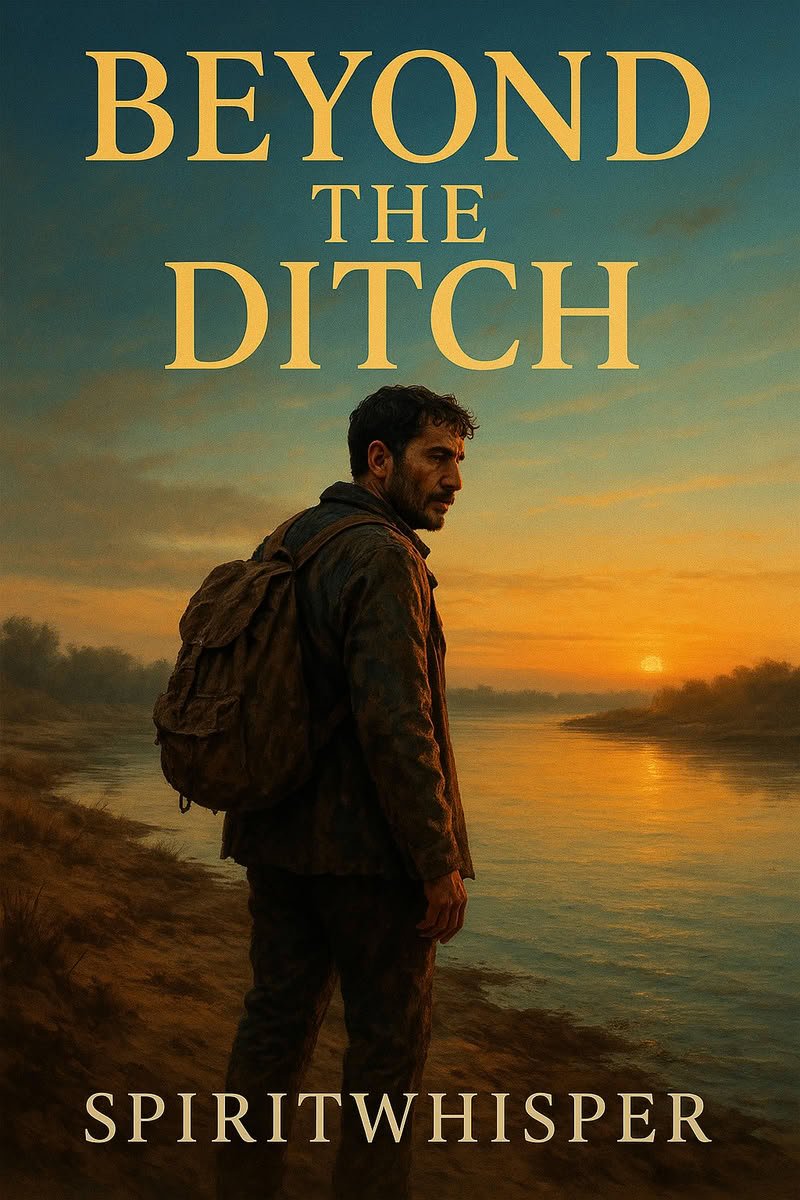
Beyond the Ditch
The story you are about to read is not an invention, but an echo. It is drawn from the life
of a real person and inspired by the true, harrowing events of a journey that tested the
limits of human endurance.
While this narrative is shaped by the craft of fiction, the foundation upon which it is
built — the desperation, the sacrifice, and the unyielding will to step beyond the shadows
of the past — is true.
This is one man’s passage, a testament to the profound cost of a new beginning, and the
resilience it takes to build a life Beyond the Ditch.
Chapter 1: The Weight of a Dream
The American dream. In the working-class apartments of Tekirdağ’s industrial city,
Çerkezköy, it was a myth whispered with a mix of reverence and desperation. It was spoken
about during tired tea breaks on factory floors, a fantasy discussed over meager family
dinners. It wasn’t just a place; it was an escape. An escape from the crushing inflation
that made a week’s wages disappear in a day, from the suffocating fear that your children’s
future would be smaller and harder than your own.
For Yalçın, this dream was a ghost that haunted his waking hours.
He was a good man, a husband, a father of two beautiful girls — one a bright, curious
four-year-old, the other a six-month-old infant whose new-baby smell still clung to his work
clothes. He loved them with a fierceness that ached. But love couldn’t pay the rent. Love
couldn’t stop the cold dread that settled in his stomach every time he passed a grocery
store.
The path to this dream was guarded by gatekeepers, the the schemers. They were men who spoke
in low tones, their networks stretching from the industrial zones of Thrace to the banks of
the Rio Grande. Their price was twelve thousand dollars.
Yalçın had scoffed when he first heard the sum. It was an astronomical figure, a king’s
ransom. It might as well have been a million. He was a factory worker, not a tycoon. He had
resigned himself to his fate. He would stay, he would struggle, and he would find a way to
survive, just as his father had before him.
But his father had not resigned. The old man saw the same struggles, the same shrinking
horizons, and he could not bear to watch his sons tread water in a sinking economy. The
family had lived apart for years — Yalçın with his own small family, his younger brother
still at home — but the bond of responsibility remained.
“You can’t go,” his father had said one evening, the words heavy and final. “You have your
girls. Your wife.”
Yalçın felt a strange mix of relief and shame. “I know, Baba. There is no money anyway.”
“I will find the money,” his father declared, a grim set to his jaw. “We will send your
brother.”
The words landed like a stone in the quiet room. Yalçın’s brother. Barely eighteen years
old. A boy whose entire existence had been a sheltered triangle between his school, his
home, and the local mosque. He was a good boy, respectful and quiet, but he knew nothing of
the world’s cruelty. He had never been in a fistfight, never navigated a strange city, never
had to lie or run to survive. His eyes were clear, unburdened by the cynicism that life
beats into a man.
“Baba, he’s just a child,” Yalçın protested, his voice low. “He isn’t ready. This… this
journey. It’s not for him.”
“Readiness is a luxury we don’t have!” his father shot back, his voice cracking with a rare
show of desperation. “He will go. I will find a way.”
And he did. The old man embarked on a humiliating pilgrimage of debt. He borrowed from his
shopkeeper, from old friends he hadn’t spoken to in years, from distant relatives who looked
at him with pity. He scraped together enough, not for the full $12,000, but for the down
payment, for the plane ticket that would set the entire, irreversible ordeal in motion.
The ticket was not to New York or Los Angeles. It was to Mexico.
The day of departure felt like a funeral. The drive from Çerkezköy to the massive,
indifferent Istanbul Airport was thick with unspoken fear. Yalçın’s mother was a silent,
weeping shadow in the car, clutching her youngest son’s arm as if she could physically hold
him back from the fate they had chosen for him. The boy himself was a picture of nervous
excitement, the true danger of his path completely obscured by the youthful fantasy of
adventure. He was worried about the long flight, not the cartel checkpoints.
At the terminal gate, Yalçın pulled his brother into a hard embrace. “Be smart,” he
whispered, his throat tight. “Trust no one. Call us. The second you get to the hotel, you
call.”
“I will, don’t worry,” the boy said, smiling, but his eyes darted nervously.
Yalçın watched him walk through security, a thin backpack on his shoulders, looking small
and terribly alone against the backdrop of the massive international terminal. He watched
until his brother was just a figure merging with the crowd, a sacrifice offered to the
family’s hope.
The plane took off, carrying the most innocent part of their family to the most dangerous
part of the world. Yalçın drove the long, quiet road back to Çerkezköy, the silence in the
car filled with a cold, creeping dread. The gamble had been made. Now, all they could do was
wait by the phone and pray.
Chapter 2: The Shattered Call
For two days, the small apartment in Çerkezköy was a vacuum of anxiety. Life moved in muted
tones. Yalçın went to the factory, his hands moving automatically, his mind thousands of
miles and an ocean away. His mother prayed, her lips moving silently over her prayer beads.
His father sat, staring at the old television, seeing nothing. Every ring of the landline,
every buzz of a cell phone, sent a jolt of electricity through them.
Then, the call came.
“He’s there,” Yalçın’s father announced, his voice thick with a relief so profound it was
almost a sob.
They crowded around the phone. The boy’s voice was thin, crackling with distance, but it was
his. He had landed. He had made it through the airport. He was in the hotel the the schemers
had arranged.
“It was scary,” he told Yalçın, “but I’m okay. The men are here. We wait, and then we go
tomorrow, I think.”
When Yalçın hung up, the tension broke. His mother wept, but this time from relief. His
father clapped him on the back, a small, proud smile returning to his face. “He’ll do it,”
he said, his confidence restored. “He’s a strong boy.”
That night, Yalçın slept soundly for the first time in weeks. He allowed himself to imagine
his brother in America, working, building a new life. He allowed himself to think that
maybe, just maybe, this impossible gamble would pay off.
The fragile peace lasted thirty-six hours.
The next call was not a hopeful check-in. It was a frantic, choked sound from a number they
didn’t recognize.
“Yalçın?”
It was his brother, but the voice was wrong. The thin, youthful tone was gone, replaced by a
raw, broken rasp that clawed at Yalçın’s nerves.
“What is it? What happened? Are you hurt?” Yalçın demanded, gripping the phone, his other
hand signaling frantically to his parents.
“They took us,” the boy sobbed, the words tumbling out in a torrent of panic. “The police…
the real police, Abi. Not the ones the sebekeci paid. They kicked the doors in. Guns… they
put guns to our heads. They took us all.”
Yalçın felt the blood drain from his face. “Where are you? Are you in jail?”
“I was,” his brother cried. “Four days, Four days in that… that place. It wasn’t a jail, it
was a hole. They… they scared us, Abi. They said they would give us to the cartel. They said
we would disappear. They kept yelling…” He choked on a sob, unable to continue.
Yalçın could hear it all in the spaces between his words: the smell of the cell, the
hardened faces of other prisoners, the absolute terror of an eighteen-year-old boy who had
never even seen the inside of a principal’s office, now trapped in a foreign prison with the
threat of being handed over to monsters.
“They let you go? You’re out? Where are you now?”
“Yes, they let us go. I don’t know why. They just… kicked us out onto the street. I have
nothing. My bag is gone. My money…” His voice broke again. “I can’t. I can’t go. I’m not…
I’m not like you. I can’t do this.”
Yalçın closed his eyes. The image of his brother, alone and terrified on a Mexican street,
was a physical weight on his chest.
“I want to come home,” the boy whispered, the last of his bravado dissolving into the
simple, desperate plea of a child. “Please, Father… I just want to come home.”
Yalçın looked at his father. The old man’s face, which had been so proud two days before,
was now a mask of gray shame. He had sent a lamb into a den of wolves. He nodded slowly, his
eyes defeated.
“Okay,” Yalçın said, his own voice heavy. “Okay, little brother. Come home. Just… just get
to the airport. We will find the money for a ticket. Just come home.”
He hung up the phone and the silence that returned to the apartment was heavier than before.
It was no longer the silence of anxiety. It was the silence of failure, of debt, and of a
dream that had just died a violent, costly death.
Chapter 3: The Father’s Gamble
The phone call had landed like a judgment. Yalçın’s brother was coming home, but the silence
he left behind was filled with the deafening sound of failure. The dream was dead, but the
debt was very much alive, and it had been paid for nothing.
There was one more call to make. Yalçın’s father, his face a mask of gray stone, made it. He
had to face the schemers.
They met in a sparse back-room office in Çerkezköy, the air thick with cigarette smoke and
the smell of cheap tea. The smuggler was not a sympathetic man. He was a businessman whose
product was human hope, and the transaction had failed.
“He’s a child,” Yalçın’s father began, his voice pleading. “He was terrified. The police…”
“The police are a risk. The cartel is a risk. The river is a risk,” the smuggler cut him
off, his voice flat. He took a long drag from his cigarette. “It’s all part of the price.
The money is gone. Paid to the contacts in Mexico City. Paid to the men at the hotel. Paid
to the driver. It doesn’t come back because a boy gets scared.”
A hot, dark anger rose in Yalçın’s chest. “He was in a Mexican jail for four days!”
“He was lucky it was only four days,” the smuggler said, looking at Yalçın for the first
time, his eyes cold and appraising. Then he turned back to the father.
“This was your mistake, old man,” he said, not unkindly, but as a simple statement of fact.
“You sent a lamb to do a lion’s job. When his older brother was right here.”
The words hung in the air, a public shaming that struck Yalçın’s father harder than a
physical blow. The old man flinched, his shoulders slumping. He had gambled with the wrong
son.
Yalçın stood up. “How much to send me?”
The smuggler smiled, a small, tight twist of his lips. The $12,000 was gone. That was the
price for the brother’s failure. But he was willing to make a new arrangement. He saw the
steel in Yalçın’s eyes, the broad shoulders of a man who worked with his hands, the quiet
desperation of a father. This one wouldn’t turn back.
“The main fee is paid in failure,” the smuggler said. “But you’ll need new transport. New
guides. A new flight. I’ll get you in the next group. You just pay for the new ticket.
That’s the deal.”
The decision was made before they even left the office. It wasn’t a choice; it was a
consequence. Yalçın was now the only way to reclaim the family’s honor, to erase the
massive, suffocating debt that now had zero chance of being repaid.
The speed of it was dizzying. Before his little brother’s plane had even touched down in
Istanbul — before Yalçın could even look him in the eye and hear the warnings
firsthand — his own ticket was booked. June 19, 2022.
The days leading up to his departure were a blur of agonizing “lasts.”
He watched his four-year-old daughter play, trying to memorize the exact sound of her
laughter, the way she tucked her hair behind her ear. How do you explain to a child that you
are leaving, and you don’t know when — or if — you will be back? You don’t. You lie. You
tell her, “Father is going on a long trip for work,” and you fight back the knot in your
throat when she asks, “Will you be back for my birthday?”
The hardest part was the baby. His six-month-old. She was pure, innocent life. He held her
against his chest for hours, her tiny hand wrapped around his finger, her head tucked under
his chin. He was leaving her. He was abandoning his wife to raise two children alone while
he chased a phantom. The economic desperation had to be stronger than the guilt. It had to
be.
He held his wife in the pre-dawn darkness of their apartment. “I will send for you,” he
whispered, a promise he wasn’t sure he could keep.
“Just stay alive, Yalçın,” she whispered back, her voice breaking. “Just… stay alive.”
On June 19th, he met the five other men from his town who were part of the same group. They
were a small band of hopefuls, five other husbands and sons, each carrying his own story of
debt and desperation. They shook hands, their smiles tight with a mixture of fear and
adrenaline.
At Istanbul Airport, they walked through the same gates his brother had. But where his
brother had been filled with a naive boy’s excitement, this group was quiet, sober. They
were men, not boys, and they knew what they were risking.
The 18-hour flight was a timeless void. They were suspended between the world they had left
and the terrifying unknown they were flying toward. There was no turning back. As the plane
began its long descent into the smog and sprawl of Mexico City, Yalçın looked out the
window. He wasn’t filled with hope. He was filled with a cold, hard resolve.
He would not fail. He could not.
Chapter 4: The First Shakedown
The plane’s wheels hit the tarmac in Mexico City with a hard, unforgiving thud. It was a
sound of finality. There was no going back.
Yalçın and his five companions from Çerkezköy exchanged nervous glances. The bravado they
had tried to muster during the 18-hour flight — the shared jokes, the quiet assurances — had
evaporated, replaced by a thick, silent apprehension. They were now on enemy soil.
The air in the terminal was hot, heavy, and loud with a language that felt aggressive and
impenetrable. They moved as a single unit, a tight knot of six men trying to look
inconspicuous and failing spectacularly.
They approached the passport control booths, their hearts hammering. This was the first
test. The schemers had said there would be “help.”
A uniformed officer looked up, his eyes scanning the line. He spotted them instantly. They
were too pale, too Turkish, too terrified. He made a small, almost imperceptible gesture
with his head, directing them to a separate, closed-off kiosk.
“by transferring it to another counter…” Yalçın’s source had mentioned this.
They shuffled over, passports in hand. The officer didn’t look at their faces. He took the
passports, stamped them with a mechanical, indifferent THUD, THUD, THUD, and pushed them
back. No questions. No “Welcome to Mexico.” They were not tourists. They were cargo,
processed and pushed through.
They stepped out of the air-conditioning and into the cauldron. The smog and the noise of
Mexico City hit them like a physical blow. They huddled on the curb, a tiny, vulnerable
island of men.
“The hotel,” one of them said, holding a scrap of paper with an address. “We get a taxi.”
A driver, his eyes sharp and practiced, spotted them immediately. He knew their kind. He saw
the desperation, the new-off-the-plane fear, the hidden wads of American dollars. He smiled
a wide, predatory smile.
“Otel? Si, si, amigos. I take you.”
Relief washed over them. They piled into the van, grateful for the small, temporary
sanctuary. The ride was short, weaving through chaotic traffic for no more than fifteen
minutes before pulling up to a nondescript, slightly rundown hotel.
The driver turned around, his smile gone. “$80.”
One of Yalçın’s friends scoffed, pulling out his wallet. “No, no. $80 for all.”
The driver’s expression hardened. He held up a single finger. “$80. Cada uno. Each.”
A ripple of disbelief and anger went through the group. “That’s crazy! It was a $5 ride!”
“We won’t pay!”
The driver didn’t argue. He simply tapped his finger on the glass of his window, pointing to
a pair of federales — federal police — standing on the corner, their hands resting on their
sidearms. The message was brutally clear. Pay me, or I hand you over to them. And they will
take everything.
They were powerless. They had been in the country for less than thirty minutes.
Swallowing their rage, they emptied their pockets. Each man handed over eighty dollars. Four
hundred and eighty dollars for a five-dollar ride. The smugglers’ $12,000 had just been the
entry fee; the real price, Yalçın realized, would be extracted from them in a thousand
small, humiliating cuts.
They grabbed their bags and walked into the dim, bleach-smelling lobby. A thin man with a
clipboard was waiting. He looked them over, his eyes as cold as the passport officer’s. He
found their names, ticked them off.
Then, he pointed to Yalçın. “You. Your schemer is different. You come with me.” He gestured
to the other five. “You all wait here. Your group is separate.”
A cold spike of panic shot through Yalçın. “No,” he said, his voice quiet. “We… we are
together. We are from the same town.”
The man shrugged, indifferent. “Your payment is with another group. You go with them.” He
jerked his thumb toward a dark corner of the lobby.
Yalçın looked. Huddled on hard plastic chairs was a collection of strangers. He saw
dark-skinned men who looked Central American, a few who looked Afghan, and others he
couldn’t place. All of them shared the same haunted, hollow-eyed stare.
“The real hardship was starting now.”
The thin, fragile safety net of his five friends — the only familiar thing in this entire
alien world — was ripped away in an instant. He wasn’t part of a group of friends anymore.
He was alone, just another anonymous soul being trafficked.
He looked back at his friends from Çerkezköy. They looked back at him, their faces a mixture
of pity and fear. They couldn’t help him.
“You wait here,” the man ordered Yalçın. “You leave in eight hours.”
Yalçın shouldered his small bag, walked over to the corner, and sat down, his back against
the wall. He was no longer Yalçın, the father, the husband, the man from Çerkezköy. He was
just a body, waiting to be moved.
Chapter 5: The Highway of Extortion
The eight hours in the dim corner of the hotel lobby felt like an eternity. Yalçın was
surrounded by strangers, all united by the common language of fear. No one spoke. Each was
lost in his own silent terror. His friends from Çerkezköy had been taken elsewhere in the
hotel. He was, definitively, alone.
Finally, the handler with the clipboard returned. He glanced at his list, then jerked his
head at the group. “It’s time. To Juarez.”
They were going to the border, to the legendary, dangerous city that sat directly opposite
El Paso, Texas.
They were herded into a van and driven back to the airport, this time to a loud, chaotic
domestic terminal, a world away from the gleaming international wing. Tickets were thrust
into their hands. As Yalçın boarded the flight, he felt his stomach clench. This flight was
the last step from civilization into the unknown.
When they landed in Juarez, the air felt different — drier, hotter, and charged with a
palpable sense of danger. As they stepped outside, a swarm of taxi drivers descended on them
like vultures. The handler pointed them toward a specific van.
The driver looked them over, smiled, and spoke in a mix of broken English and Spanish. “El
Paso. The border. Seven-hour drive.” He then named his price. “Three hundred dollars. Cada
uno. Each.”
A curse died in Yalçın’s throat. After the $80 shakedown, now this. Someone in the group
started to argue. “That’s robbery! This is a cheap ride!”
The driver just shrugged. “Then stay here, amigo. We’ll see who finds you first. The
federales or the sicarios.”
It wasn’t a negotiation. It was a demand. The money was collected, counted into the driver’s
hand. The van lurched to life and headed out of the city, into the vast, unending expanse of
the Chihuahuan Desert.
The journey was seven hours of bone-jarring vibration, dust, and tense silence. Yalçın
stared out the window, thinking of his daughters. He was enduring this humiliation for the
sake of their faces.
About three hours in, they saw the flashing blue and red lights ahead. Mexican police. A
roadblock.
The driver slowed to a stop and cheerfully rolled down his window. A police officer walked
over slowly, his face impassive. He took a long look at the passengers, at the cargo of
exhausted, terrified men. He spoke briefly to the driver in Spanish, then held out his hand.
The driver turned around. “Tax time,” he said without a trace of shame. “One hundred
dollars. Each man. Now.”
“But we paid you!” someone yelled.
“You paid me,” the driver agreed. “You didn’t pay them. You pay, or we all get taken.”
The threat was clear. Yalçın remembered his brother’s story: “If you resist, they take you
to jail, or send you back to Turkey. Or they hand you over to the cartels.”
Again, they dug into their pockets. The money was collected, folded, and passed out the
window. The officer took it, stuffed it into his pocket without counting, and waved them on.
The van sped up. Yalçın’s blood was boiling. He felt robbed, humiliated.
But the ordeal wasn’t over.
Two hours later, another checkpoint. A different set of uniforms, but the exact same script.
The same bored looks, the same outstretched hand, the same price. One hundred dollars. Each.
In total, on a single seven-hour ride, they had been bled for $500 per person in bribes and
fees. The $12,000 paid to the sebekeci, Yalçın now understood, was just the cover charge to
enter this corrupt ecosystem.
As the sun began to dip toward the horizon, painting the desert in hues of orange and
purple, the van finally slowed. It didn’t pull into a city or up to a house. It pulled over
onto a desolate patch of dirt on the side of the highway.
The driver killed the engine and turned around. “We’re here,” he said. “Get out.”
Chapter 6: The Ditch
“Out. Now.”
The driver’s voice was sharp, urgent. Yalçın and the others tumbled out of the van onto the
loose gravel. The air was cool, the sun a dying ember on the horizon. They were in the
middle of nowhere, just a dark, two-lane highway stretching into infinity in both
directions, flanked by desert scrub.
The driver pointed into the darkness on the other side of the road. “You see that hill?” he
said, his voice low. “You will cross the highway. You will climb that hill. On the other
side… you run.”
He stepped closer, his face grim. “It is one kilometer. You do not stop. You do not slow
down. You run. At the end is a large ditch, full of water. That is the border. You cross
it.”
He grabbed the arm of the man closest to him. “Listen to me. The Policía de México patrol
this road. If they catch you here,” he squeezed the man’s arm, “they have orders. They can
kill you. No questions asked. You understand? They will shoot.”
A cold, electric shock of pure terror passed through the group. This wasn’t about bribes
anymore. This was about survival.
“Wait for no cars,” the driver ordered. “Go.”
There was no time to think. They sprinted across the dark highway, the beams of a distant
truck sweeping toward them. They scrambled up the loose scree of the hill, rocks slipping
under their feet. At the top, they paused for half a second.
Before them was a flat, dark expanse of brushland. And at the far end, perhaps a kilometer
away, they could just make out a deeper shadow, a cut in the earth. The ditch.
“Run!” someone screamed.
They ran.
It was a desperate, panicked sprint. Their lungs burned. The only sounds were their own
ragged breathing and the frantic pounding of boots on the hard desert soil. They were a pack
of hunted animals, running from a predator they couldn’t see.
Then they heard it. The high-pitched whine of an engine.
Yalçın chanced a look over his shoulder. Headlights. A patrol truck, off-road, bouncing over
the terrain, coming for them, and coming fast.
“POLICÍA! ALTO!”
The shout was followed by the cold, metallic clack-clack of a round being chambered into a
rifle.
“They’re here! Go! Go! Go!”
The group broke apart in pure, animal panic. All pretense of order was gone. They were no
longer men; they were just raw fear, running for their lives. The ditch was close now, just
fifty meters.
The truck was gaining, its headlights pinning them like fleeing rabbits.
“INTO THE WATER!”
One by one, the men in front of Yalçın launched themselves into the darkness, followed by
the sound of a heavy, desperate splash. Yalçın was right behind them. The bank of the ditch
was one step away. He gathered himself to leap.
A hand clamped onto his shoulder like a steel trap.
He was spun around. A Mexican police officer, his face contorted in rage, had him. The
ditch — the border, safety, America — was literally one footstep behind him. But he was
caught.
As the officer grabbed him, Yalçın’s survival instinct took over. He didn’t try to pull
away. He lunged forward. He wrapped one arm around the officer’s neck, his other hand
instinctively grabbing the man’s holstered sidearm, not to pull it, but to hold on, to make
himself part of the officer.
Out of the corner of his eye, he saw the second officer leaping from the truck, running
toward them.
His mind went crystal clear. Two officers meant he was finished. He would be beaten,
arrested, or worse. He had one chance. One.
“My only option was to grab the cop and throw us both into the water.”
With a desperate, primal roar, Yalçın tightened his grip on the officer’s collar and the
gun. He didn’t push. He fell, using his entire body weight to pull the larger man off
balance.
For a split second, they were suspended, a tangle of limbs on the crumbling edge. Then,
together, they crashed into the water.
The cold was a violent shock. They went under, swallowing the muddy, foul-tasting water. The
force of the fall and the powerful current of the ditch — this was no ditch, it was the Rio
Grande — tore the officer’s grip from his shoulder.
Yalçın kicked, his legs burning. He broke the surface, gasping, and scrambled at the
opposite bank. It was steep, slick with mud. He clawed at the dirt, his fingers finding a
root. He hauled himself up, half-crawling, half-falling, and collapsed onto the
bank.
He was covered in mud, soaking wet, and his heart felt like it would explode. He rolled onto
his back, sucking in the air.
He was on American soil.
From the other side of the river, he heard shouting. The second officer was at the water’s
edge, his gun drawn but pointed at the sky. His partner was sputtering, trying to climb back
up the Mexican side.
“Hey! Ven acá!” the officer yelled, waving his arm. “Come back! Come back here!”
Yalçın just lay there, panting. He had no strength to get up. He looked at the furious,
helpless officer across the water. A deep, shuddering breath filled his lungs. It was the
first clean breath he had taken since leaving Çerkezköy.
He was in America. And they could no longer touch him.
Chapter 7: The Price of the Dream
Yalçın lay on the muddy bank of the Rio Grande, his chest heaving, for what felt like an
hour. He was an island of soaking, trembling humanity in the vast Texas dark. The shouts of
the Mexican police faded behind him, replaced by the chirping of crickets and the pounding
of his own heart. He was here. He had made it. But he was not yet free.
Eventually, the blue and white lights of the U.S. Border Patrol swept over him. There was no
aggression in their approach, just a weary, bureaucratic efficiency.
“On your feet,” one of the agents said, his voice devoid of emotion.
Yalçın was processed with the rest of his group, who had been rounded up nearby. The first
step was a humiliation that felt almost ritualistic. They were taken to a room and told to
strip. “Anadan doğma,” Yalçın would later recall. Stark naked. They were ordered to shower,
a cold, antiseptic spray that washed off the Rio Grande mud but not the grime of the
journey. They were handed gray sweatpants, t-shirts, and thin slippers. Their old lives,
their clothes, their identities, were stuffed into a plastic bag.
Then came the questions, the photographs, the fingerprinting. They were numbers in a system.
He was placed in a large, cold holding cell in Texas. The cell block. The days blurred into
a monotonous cycle of sterile cold and gnawing hunger. They were given nothing but apples
and water. For six days, Yalçın survived on this, the acid from the apples eating at his
empty stomach, his hope beginning to curdle into a new kind of despair. This wasn’t the
America he had dreamed of. This was just a cleaner, colder prison.
On the sixth day, a guard called his name. A jolt of pure joy shot through him. “I’m being
released.”
He was wrong.
He and thirty other men were shackled. Not just handcuffs. They were chained at the wrists,
at the waist, and at the ankles. The cold steel bit into his skin. This, he thought, his
stomach dropping, is for criminals.
They were herded onto a bus, the chains clinking with every movement. For six agonizing
hours, they drove, the metal cutting into their flesh. They arrived at a military airfield,
a place not meant for civilians, and were ordered to wait on the tarmac, still chained, for
another four hours. The sun beat down on them. They were given no water.
Finally, they were loaded onto a cargo plane, the kind used for military transport. The
seats were hard metal benches. They were still chained, hand to waist, waist to ankle. The
flight lasted another six hours, a journey of excruciating discomfort. By the time they
landed, Yalçın could no longer feel his hands or feet. The steel had become a part of him.
They were in Louisiana.
The moment they landed, they were moved without wasting a moment, onto another bus. Another
four-hour drive. The pain was no longer a sharp bite; it was a deep, throbbing, permanent
ache. He looked at his fellow prisoners, their faces gray with exhaustion and pain. He
cursed himself. He cursed the schemers. He cursed the dream. Why did I come? Why did I leave
my children for this?
At last, the bus rumbled to a stop. They had arrived at the Louisiana Riverbend Detention
Center.
The sound of the chains finally being unlocked was the sweetest sound he had ever heard. The
relief was so intense, it was almost painful. They were given food — real, hot food — and
allowed to shower. They were handed a bag filled with hygiene supplies and a fresh set of
clothes. It was the first act of basic human dignity they had been shown since stepping on
American soil.
That camp, a sprawling complex of barbed wire and temporary buildings, became his world. He
was no longer Yalçın, the father from Çerkezköy. He was detainee #A089…
One day became a week. A week became a month. The seasons began to change. He watched men
come and go — some deported, some released to family. He had no one. He was trapped in a
legal limbo, thousands of miles from everyone he loved, his only contact with his wife a few
strained, tearful minutes on a monitored phone. He counted the days. 50. 100. 150.
He had been a prisoner for 187 days.
Six months after he had thrown himself into the Rio Grande, his name was called again. This
time, it was real. A judge had granted him bond. The price for his release: $10,000.
It was another impossible sum, but back in Çerkezköy, his father, shamed but resolute, had
not been idle. He had sold his wife’s gold, he had borrowed from every soul he knew. He had
sold his own small, broken-down car. He scraped together the money and sent it.
On a cold winter day, 187 days after his capture, Yalçın walked out of the Louisiana
Riverbend Detention Center. He was free. He had nothing but the clothes on his back, a bus
ticket to a city he’d never heard of, and a court date.
Years later. The clatter of machinery and the screech of packing tape fill the air of a vast
warehouse in New Jersey. The pace is frantic, the work hard.
A forklift, its horn beeping, reverses, and a young man on a pallet jack calls out. “Yalçın!
I need a count on aisle five!”
“One minute!”
A man nods, checking a clipboard. He is fit, his face weathered by work and worry, but his
eyes are clear. It is Yalçın. He wears the navy blue polo of a supervisor.
His journey here was another story in itself — months of working under the table for cash,
living in crowded rooms, sending every single dollar he earned back to Turkey. First, to pay
the $10,000 bond. Then, to pay his father’s original debts. Then, to feed his family.
His phone buzzes. He pulls it out. It’s a photo from his wife. His oldest daughter, now a
young girl, is standing in front of a new apartment building in Çerkezköy, holding a set of
keys. She is smiling. He smiles, a deep, genuine smile that reaches his eyes.
He has paid for it all. The debt, the smugglers, the bond. He bought the house for his
family. He sends money for their clothes, their food, their education. He has saved money.
He has built a new life from nothing, just as the dream had promised.
“Yalçın, my friend. Good work today.”
Yalçın turns. His Manager — the man who gave him his first real job, the man who trusted
him, the man for whom this very story is being written — is standing there, clapping him on
the shoulder.
“Thank you, Usta,” Yalçın says, using the Turkish word for ‘Master’ or ‘Mentor’ — a sign of
deep respect.
“You’re the supervisor,” Mutlu says, laughing. “You’re the boss of this floor. But you still
call me Usta.”
Yalçın just nods, his smile lingering. He looks at his hands, calloused from work, not from
chains. He thinks of the ditch, the gun, the officer’s face. He thinks of the 187 days in
that Louisiana camp. He thinks of the 6-month-old baby he left.
He had arrived in America with nothing but the muddy clothes on his back, a refugee from a
broken economy. Now, he is a supervisor. A provider. A homeowner. He is, by every measure,
the man he had crossed a desert and a river to become. He had paid the price, and he had,
against all odds, won.
He turns back to the bustling warehouse. “Okay,” Yalçın says, clicking his pen. “