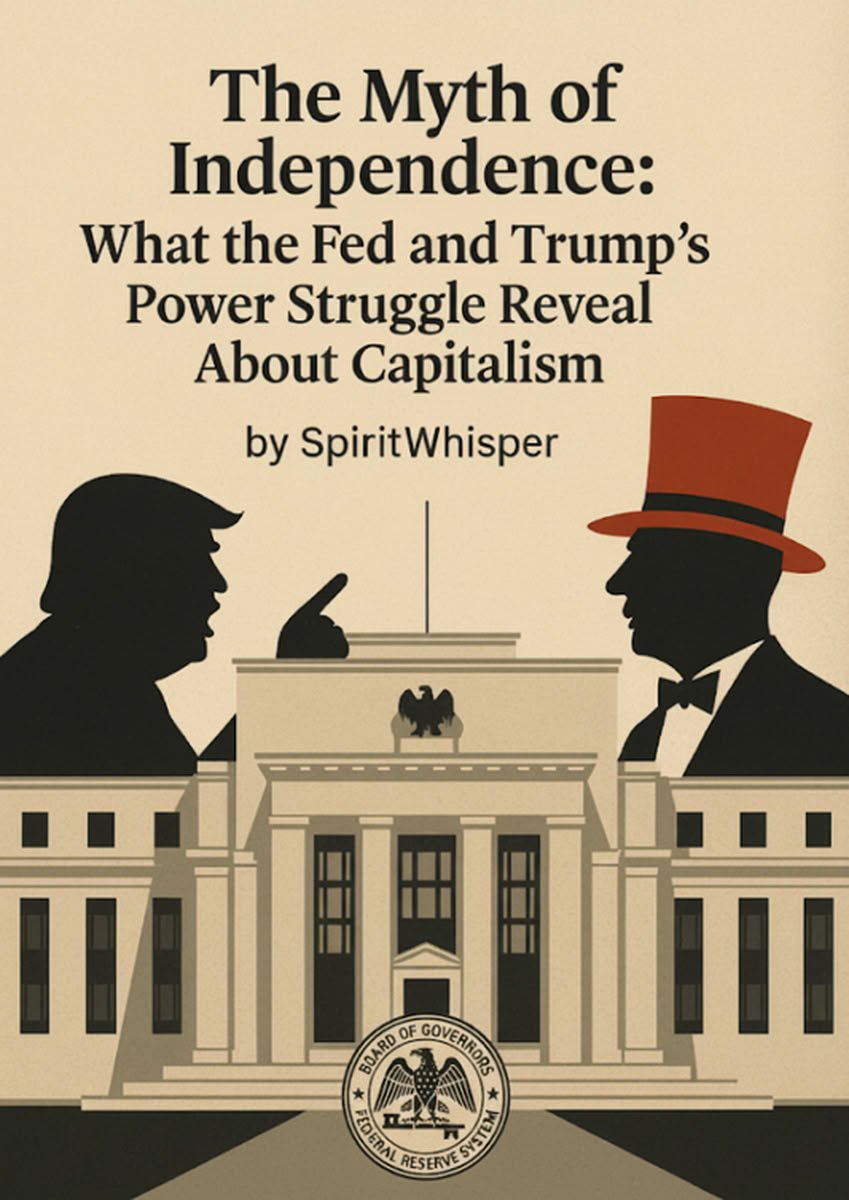
The Myth of Independence: What the Fed and Trump’s Power Struggle Reveal About Capitalism
When the headlines warn that Donald Trump’s attempts to remove Federal Reserve Governor Lisa
Cook could throw financial markets into “chaos and disruption,” we are supposed to be alarmed.
We are told that an independent Federal Reserve is sacred, that its insulation from political
interference is what guarantees stability. But if we take even a small step back and look at
this situation through an anti-capitalist lens, a different reality emerges: the Fed has never
been independent in any meaningful sense. It has always been an instrument designed to safeguard
capital, and this latest political clash simply exposes that fact more clearly than
usual.
The Manufactured Illusion of Independence
The Federal Reserve is celebrated as a neutral guardian of the economy, a technocratic body
above the political fray. In reality, it exists to serve the stability of the capitalist system
itself. Its tools—interest rates, liquidity injections, bond-buying programs—are wielded not to
improve the daily lives of workers, but to protect banks, corporations, and investors.
We only need to recall the financial crisis of 2008, or the pandemic shock of 2020, to see how
this plays out. When instability hit, the Fed rushed to pump trillions into financial markets to
rescue banks and corporations. Did ordinary people receive the same level of urgency and
support? No. While Wall Street was saved overnight, millions of working people faced
unemployment, eviction, and spiraling debt. Independence, in this sense, means independence from
accountability to the public, while maintaining absolute dependence on the demands of capital.
Trump’s Move: Power Struggles Inside the House of Capital
Trump’s attempt to remove Lisa Cook is portrayed as an attack on institutional norms. But from
an anti-capitalist perspective, this is simply one faction of capital attacking another.
Capitalism has always been riddled with internal rivalries—finance capital, industrial capital,
political elites—vying for control over the same machinery of exploitation.
Trump is not challenging the foundations of the Fed’s role in the economy. He is not demanding
that workers have a say in monetary policy. He is simply trying to tilt the balance of power to
his allies and interests. Whether Cook stays or goes, the institution remains what it has always
been: a fortress for the wealthy, immune from genuine democratic influence.
“Chaos” for Whom?
The warnings about “chaos in the markets” are particularly revealing. What chaos are they
talking about? For the working class, chaos is not a hypothetical risk—it is the daily condition
of life under capitalism. Stagnant wages, precarious jobs, crushing debt, and the constant fear
of losing health care or housing are the baseline reality for millions.
When officials warn about chaos, they mean volatility in stock prices or investor confidence.
They mean disruption to the smooth functioning of speculative capital. In other words, the
“stability” they defend is a stability that only applies to the ruling class. For everyone else,
capitalism is already a storm.
The Fed’s Crisis of Legitimacy
What Trump’s intervention inadvertently reveals is that the façade of neutrality is fragile. If
the President can attempt to dismiss a Fed governor at will, then the myth of independence
collapses. But should we mourn the loss of this myth? Not if we recognize that independence was
always a smokescreen.
The Fed’s legitimacy depends on convincing the public that it represents the national interest
rather than class interest. Once the curtain is pulled back, once people see the naked struggle
between political power and financial elites, the possibility for a deeper critique opens up.
The question is not whether the Fed is independent, but whether any institution built to serve
capital can ever act in the interest of the majority.
Toward Democratic Control of the Economy
An anti-capitalist perspective demands more than defending a hollow status quo. Instead of
debating whether Trump or Cook should hold power, we should ask: why should such enormous power
rest in the hands of a tiny elite in the first place?
Imagine a central bank not run by unelected technocrats or captured politicians, but by
representatives of workers, unions, and communities. Imagine decisions about interest rates and
credit allocation being made with the explicit goal of securing full employment, housing,
education, and healthcare for all—not the maximization of shareholder returns. This is not
utopian fantasy; it is a recognition that the economy, as it stands, is governed by a
dictatorship of capital, and that genuine democracy must extend to the economic sphere.
The Broader Lesson
Trump’s clash with the Fed is not an anomaly; it is a symptom of capitalism’s permanent
instability. The system breeds conflict, crisis, and corruption because it is founded on
exploitation. Whether markets are “stable” or “in chaos,” workers remain disposable, communities
remain underfunded, and the planet itself remains at risk from endless growth
imperatives.
So when commentators tell us that protecting the Fed’s independence is essential to stability,
we must ask: stability for whom? For Wall Street traders? For multinational corporations? True
stability will never come from preserving the institutions of capital. It will come only when we
dismantle those institutions and replace them with structures built by and for the working
class.
Exposing the Real Chaos
Trump’s move against Lisa Cook may be framed as a dangerous attack on norms, but it actually
performs a useful service. It strips away the illusion that the Federal Reserve—or any
capitalist institution—is above politics. It shows that even at the highest levels of finance,
the system is nothing more than a battlefield for rival elites.
For workers, the challenge is not to defend the supposed independence of the Fed, but to reject
the very premise that the health of the economy should be defined by the health of financial
markets. The real chaos is the daily life of exploitation under capitalism. The real disruption
we need is the disruption of that order.
Until we replace capitalism with a system grounded in solidarity, equality, and democratic
control of resources, we will continue to witness these manufactured crises at the top—while
living through the permanent crisis at the bottom.