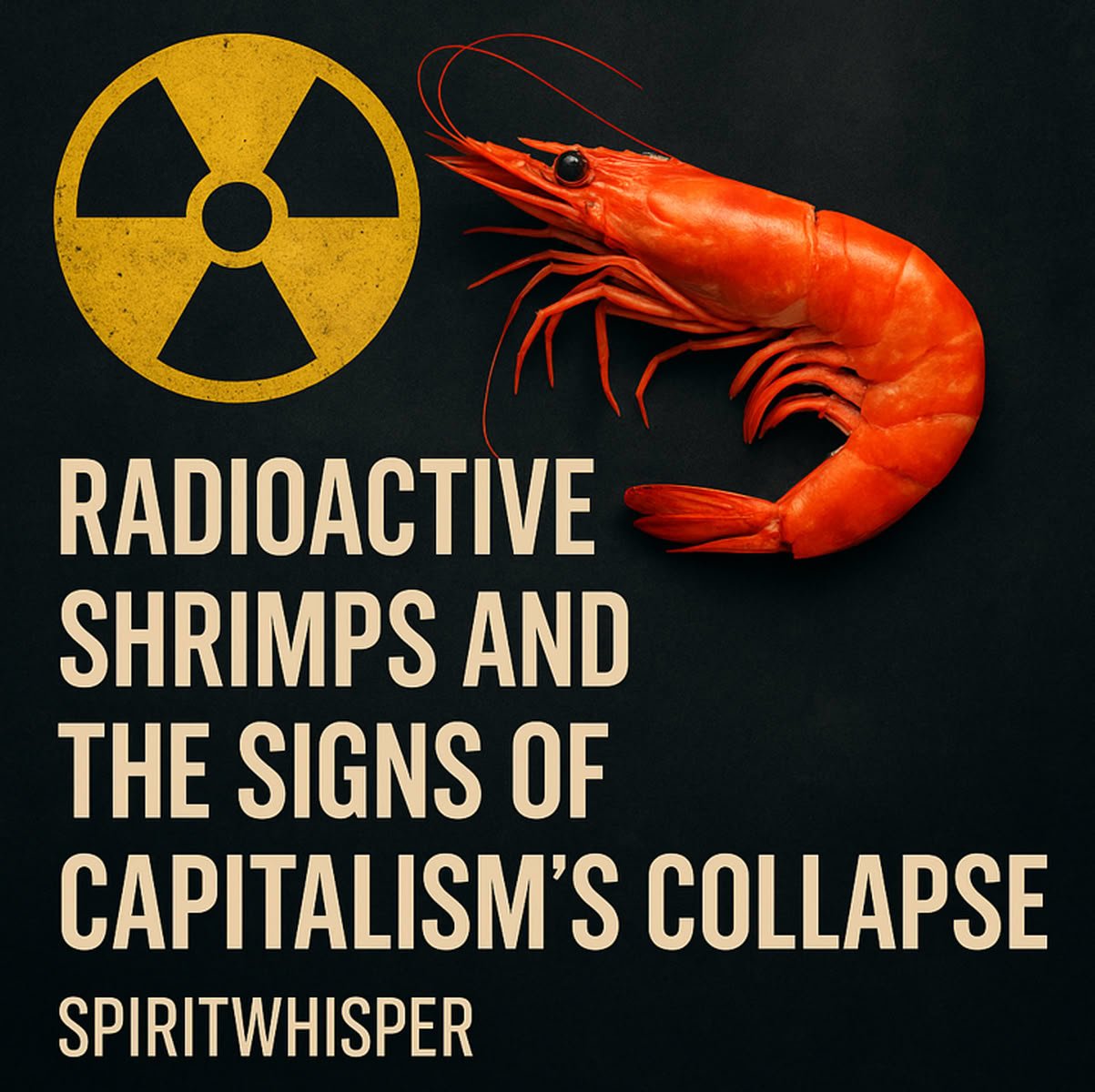
Radioactive Shrimps and the Signs of Capitalism’s Collapse
For News
Every time a food scandal breaks into the headlines, the same pattern repeats itself. A shocking
discovery — a contamination, a recall, a “temporary ban.” Authorities rush to calm the public,
companies issue polished statements, and consumers are left with a bitter aftertaste of
distrust. And then, after a few days, the story disappears. Life goes on. Shrimps continue to be
sold, spices continue to be imported, and the machinery of global trade continues to grind
forward as if nothing happened.
But let’s pause for a moment. Let’s ask the question that no press release, no corporate PR
department, and no regulatory authority dares to ask out loud: what do radioactive
shrimps tell us about the system we live in?
Because at the end of the day, this isn’t really about shrimps. It’s not even about one
contaminated shipment or a negligent company. It is about the deeper sickness of a system that
treats human life as a statistic, health as a commodity, and safety as an afterthought — so long
as profits keep flowing.
The Invisible Poison of Profit
Capitalism thrives on a simple equation: reduce costs, increase output, maximize margins.
Everything else — ethics, sustainability, even basic safety — comes second. If companies can
produce ten million pounds of shrimp for half the price by cutting corners, they will. If
suppliers can push products onto global shelves without proper checks, they will. If
contamination slips through and only gets caught at the last checkpoint, the system shrugs and
says: well, accidents happen.
But accidents don’t just “happen” in a vacuum. They happen because the incentives are broken.
When the relentless pursuit of profit becomes the organizing principle of society, then
radioactive shrimps are not anomalies — they are inevitabilities.
Capitalism’s Hunger Knows No Boundaries
Look at the global food supply chain. Your dinner plate today might include shrimp from
Indonesia, rice from India, beef from Brazil, and spices from a dozen countries. On the surface,
this sounds like a triumph of globalization — a world of abundance, variety, and connection. But
beneath the surface lies a much darker reality:
- Food is shipped thousands of miles not because it’s healthier or safer, but because it’s cheaper.
- Regulations are bent, ignored, or outright falsified to keep exports flowing.
- Consumers have no idea where their food comes from, what chemicals are used, or what hidden risks they are swallowing.
Capitalism celebrates this as “efficiency.” I call it organized negligence on a global
scale.
When Safety Becomes a Luxury
Here’s the cruel irony: in a capitalist system, safety is never a guarantee — it’s a privilege.
If you can afford organic, locally sourced products, you can somewhat escape the roulette of
contamination. But if you live paycheck to paycheck, you’re left with the cheapest options, and
the cheapest options are often the most dangerous ones.
This isn’t an accident; it’s structural violence. It’s a deliberate hierarchy where those with
money can buy a little more safety, while everyone else becomes a testing ground for whatever
poisons global trade pushes onto the shelves.
Radioactive Shrimps Are a Symptom, Not the Disease
Think of capitalism as a decaying body. The scandals we see — radioactive shrimps, toxic baby
formula, pesticide-soaked produce — are just the visible symptoms of a deeper illness. They are
the tumors breaking through the skin, revealing a system that has been sick for a long
time.
And just like a body riddled with disease, capitalism tries to cover its wounds with bandages. A
recall here, a fine there, a public apology sprinkled with corporate jargon. But the disease
keeps spreading. Because the disease is not one company, one shipment, or one corrupt official —
the disease is the entire logic of profit over life.
The Collapse Is Already Here
Some people talk about capitalism collapsing in the future, as if it will be some dramatic event
with riots in the streets and governments falling overnight. But the truth is quieter and more
insidious. Collapse doesn’t always look like explosions; sometimes it looks like a slow erosion
of trust, a daily realization that the system no longer serves life.
When people start asking, “Can I even trust the food I eat?” — that’s collapse.
When entire generations grow up sicker, more anxious, and more distrustful than their parents —
that’s collapse.
When corporations treat fines as just another “cost of doing business” while consumers pay the
price with their health — that’s collapse.
Capitalism isn’t heading toward collapse. It is already collapsing. The radioactive shrimp is
just another crack in the façade.
Toward a Different Future
The obvious question then is: what comes after? If capitalism can’t keep our food safe, can’t
keep our environment clean, and can’t keep people healthy, what alternative do we have?
The answer begins with rejecting the illusion that profit-driven corporations can ever
prioritize human well-being. We need systems built on collective responsibility, not private
greed. We need food production that values sustainability over speed, and communities that
prioritize health over margins. We need to reconnect with the very basics of human survival:
food, water, safety — not as commodities to be bought and sold, but as rights to be protected
and shared.
Hope
A shrimp laced with radiation may sound absurd, almost cartoonish, like the plot of a dystopian
film. But it is real. It happened. And it will keep happening, because the system that created
it remains intact.
We should stop laughing at the absurdity and start seeing it for what it is: a warning sign. A
glowing, radioactive warning sign that tells us capitalism has reached its natural conclusion —
decay, corruption, and collapse.
The choice before us is clear: do we keep pretending that the system can fix itself,
or do we start building something radically different, something that actually values
life over profit?
Until then, every shrimp on our plate is a reminder — not of abundance, but of how
rotten the foundations of this world have become.